
Applying for Tax Exempt Status

Q: Does our church have tax-exempt status or do we need to apply for it? When does a church need an Employer Identification Number?

A: The IRS has automatically granted churches with federal tax-exempt status and the right to grant charitable contribution credit to donors without any action being taken by the church. However, some donors may wish to verify with the IRS that your church is registered as an approved 501(c)(3) organization and that contributions to your church will be tax deductible.

For Assemblies of God churches, in order for your church to be identified on the IRS system as a church that falls under the General Council of the Assemblies of God’s tax-exempt umbrella, you must have an EIN (Employer Identification Number) and report this to the General Council on your ACMR report. The General Council submits a listing of all of the Assemblies of God churches with their respective EINs so that each church can be properly identified on the IRS system as an Assemblies of God church, and therefore, properly covered by the General Council’s tax-exempt status.

Without an EIN, an organization cannot be entered into the IRS system. If a church will have a bank account in its name, have employees, or conduct any business in its own name (including receipting contributions to donors), it must apply for and obtain its own EIN. An EIN can be obtained by completing an IRS Form SS-4 and submitting the form either by mail or fax to the IRS. An EIN may also be obtained over the phone or online. For instructions on obtaining an EIN, see “How to Apply for an EIN” on the IRS website ww.irs.gov.

To obtain exemption for sales tax and property tax, you may have to register with your state (and perhaps the IRS). The various states differ on their rules and application process, so check with your respective Secretary of State's office.

Due to the various state rules, you may want to consult a qualified attorney or CPA for additional help.
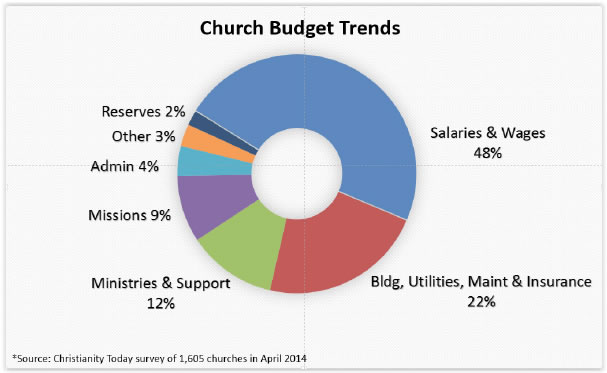

These percentages are not meant to be prescriptive, but comparing your church activity to these averages may be helpful or insightful.

Here are some additional ideas to consider as you develop and review your budget:

  • Seek counsel within your network of pastors who may be in a similar sized church or face similar socio-economic factors. Even if your church doesn’t fit precisely into the same model as another church, the comparison of where your church is on staffing levels, debt, facility expenses, number of individuals being served, etc., can be extremely valuable in helping you establish an appropriate budget for your church.
  • Consider your mission and vision for the church. Create a budget that reflects those priorities. For example, if the church has a vision to reach young families, more funds may be allocated to developing family-friendly environments, programs, and outreach opportunities.
  • Consult experienced members within your church for help. Find businessmen and -women within your church who create and execute budgets as part of their daily job. They will have expertise that will be invaluable to you.
  • Lastly, the IRS requires compensation provided to ministers to be reasonable. As you create your budget and review compensation packages, one way to determine reasonableness is to consult independent compensation surveys for comparison. Christianity Today has a great compensation tool for churches.  You can find that at churchsalary.com.

The Southern Baptist Convention also publishes a compensation survey that is freely available on their website.

Related Posts

8 Steps for Improving Teamwork

8 Steps for Improving Teamwork

Teamwork is essential in any sport, company or church. Without teamwork, we place a lid on the capacity of the organization, department or ministry we lead. The old saying really is true — “teamwork makes the dream work.” Download this eight week study guide to go...

read more...