What are appropriate budget percentages for our church? This is a common question that arises every time a church budget is created. Unfortunately, there is no clear-cut answer.
What one church spends on personnel costs shouldn’t dictate what another church can spend (or afford) in personnel costs. What each church spends will depend on the unique circumstances of each church, and these budget percentages are certainly influenced by the strategic vision of the church and other socio-economic factors in and around the church. While churches have many things in common, no one church is like another. Churches will vary in revenue, staffing, infrastructure, ministry programs, and debt, which makes it difficult to make a generalized statement about how much of the church’s budget should be allocated to certain functions in the church.
One lending institution stated that in order to provide a loan to a church, they require that debt and salaries should be no more than 70% of undesignated tithes and offerings. This allows 30% for operations and ministry programs.
Other churches ascribe to the 33/33/33 model: 33% is allocated to salaries, 33% is allocated to operations/programs, and 33% is allocated to building and infrastructure.
However, this cookie-cutter approach doesn’t fit all churches.
For example, a new church plant may have to rely on volunteers and a bi-vocational pastor to fill key roles in the church. This young church may have lower personnel costs, but expend a larger percentage of the budget for facility rental and outreach. On the other hand, a church that has no building debt may be able to spend more on staffing and may incur personnel costs that exceed 50% of its budget.
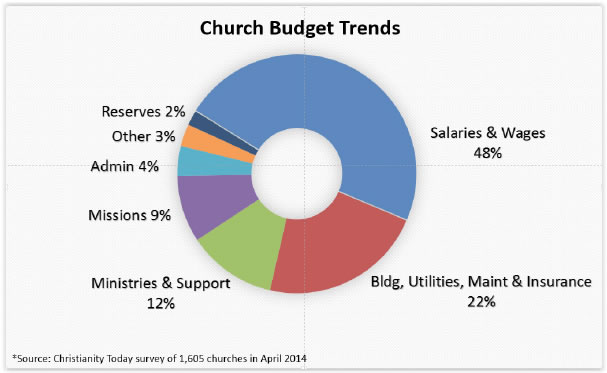
In April 2014, Christianity Today surveyed 1,605 churches and identified budget trends. The following chart identifies the average budget percentages in key functions at these churches.