
Charitable Giving Credit for Church Camp Fees

Q: If a person gives money to sponsor a child to go to church camp they can receive charitable giving credit. However, if a parent pays for their child to go to church camp, they do not receive charitable giving credit. Am I understanding this correctly?

A: Yes, your conclusions are correct. While it may seem a bit unfair, the rationale is based on who is receiving the benefit of the donor’s contribution. According to the IRS, if a person wants to give a donation to a church and get a tax deduction, the donor must relinquish control and allow the church to use the donation as it deems best. Similarly, in order for a donor to receive charitable giving credit for tax purposes, the donor cannot stipulate how the funds are to be used, or receive a benefit from the donation (other than intangible religious benefits).

Consider the following examples:

  • If a donor makes a contribution to the church camp scholarship fund and notes that the funds should be used to send a needy child to camp, the donor can receive charitable contribution credit for the entire amount.
  • If a donor gives money to the church camp scholarship fund and says the money must be used for their own child, the donor can’t claim a deduction, because they have received a tangible and personal benefit from the donation.
  • However, if the donor gives $100 to the church and receives a thank-you gift valued at $40, the donor is only able to receive charitable giving credit for $60 because the donor received a tangible benefit of $40 (and the church receipt should clearly spell this out).
  • Similarly, if the donor gives money to the church’s benevolence fund and says it must be given to the Smith family who just had a house fire, the donor can’t claim a charitable deduction. The donor is restricting the gift and forcing the church to use the gift for a specific purpose. This is contrary to IRS rules for charitable giving.

You might wonder how this is different from giving to a church building fund, or to a special offering to provide water wells. The assumption is that these are approved projects initiated by the church governing board. If the board initiates a project, a donor can specify and restrict funds for that project and still receive a tax deduction for charitable giving.
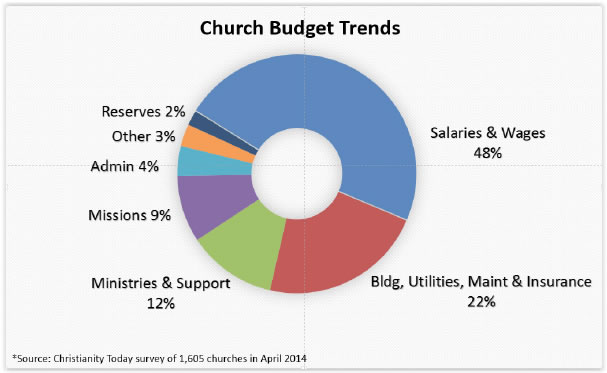

These percentages are not meant to be prescriptive, but comparing your church activity to these averages may be helpful or insightful.

Here are some additional ideas to consider as you develop and review your budget:

  • Seek counsel within your network of pastors who may be in a similar sized church or face similar socio-economic factors. Even if your church doesn’t fit precisely into the same model as another church, the comparison of where your church is on staffing levels, debt, facility expenses, number of individuals being served, etc., can be extremely valuable in helping you establish an appropriate budget for your church.
  • Consider your mission and vision for the church. Create a budget that reflects those priorities. For example, if the church has a vision to reach young families, more funds may be allocated to developing family-friendly environments, programs, and outreach opportunities.
  • Consult experienced members within your church for help. Find businessmen and -women within your church who create and execute budgets as part of their daily job. They will have expertise that will be invaluable to you.
  • Lastly, the IRS requires compensation provided to ministers to be reasonable. As you create your budget and review compensation packages, one way to determine reasonableness is to consult independent compensation surveys for comparison. Christianity Today has a great compensation tool for churches.  You can find that at churchsalary.com.

The Southern Baptist Convention also publishes a compensation survey that is freely available on their website.

Related Posts

5 Giving Methods for Your Church

5 Giving Methods for Your Church

According to a recent article by Art Rainer, Millennials are a generous group, but many churches may be missing out on their generosity due to outdated giving methods and ideas. Consider these recent surveys describing people's money habits: A 2015 survey by the...

read more...
Benevolence Program Basics

Benevolence Program Basics

Catastrophic events like wildfires, hurricanes and the recent tornadoes in the Midwest highlight the tremendous need for compassion ministries. While there are signs the recent economic downturn is reversing, more than half the states still have unemployment rates...

read more...
Charitable Contribution Receipts

Charitable Contribution Receipts

Charitable contributions are the lifeblood of nonprofits. In one recent year, public charities reported receiving $316 billion in charitable giving. One-third of those donations were given to religious organizations. There are several types of donations a church may...

read more...