
The Millionaire Retirement Standard

There is a level of prestige associated with one million that other numbers don’t possess.

Many consider one million dollars to be the magic number for retirement. Have it and you’re in good shape; fall short and you’re in for a tough time. But is that true? Do you really need a million dollars in order to retire?

The answer is an old favorite: it depends.

Here are some things to consider:

Life Expectancy

According to the Society of Actuaries, for a married 65-year-old couple, there is a 45% chance of one person reaching age 90 and a 20% chance one will reach age 95. Your retirement funds may need to sustain you for a few decades, not merely a few years.

Inflation

Having just enough for retirement today could mean years of struggling down the road if inflation is not considered. For instance, based on an average inflation rate of 3.5%, prices would double every 20 years. Or to put it another way, $1,000 today may only have the spending power of $500 in 20 years.

Medical Costs

Health costs tend to rise as you get older. Even with healthcare benefits, a healthy 65-year-old couple could spend upwards of $250,000 on out-of-pocket medical expenses. Medical expenses are typically the biggest and most unpredictable retirement expense.

Lifestyle Expenses

What do you want to do in retirement? Travel? Spend time with family? Estimate the costs associated with your desired lifestyle because how you spend money in retirement may be more important than how much you have saved for retirement.

What can you do now?

First, you will want to estimate your retirement savings needs. Then look at the three factors that influence your retirement savings outcome:

There’s no one-size-fits-all retirement plan, but with careful planning and self-restraint, you can experience a financially stable retirement, whether or not you hit millionaire status.

Article originally posted on the AG Financial Solutions website.
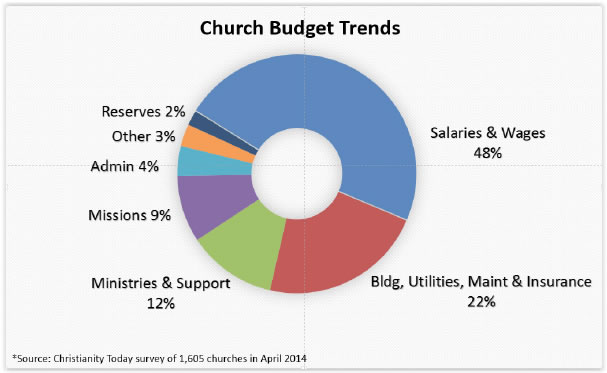
These percentages are not meant to be prescriptive, but comparing your church activity to these averages may be helpful or insightful.

Here are some additional ideas to consider as you develop and review your budget:

  • Seek counsel within your network of pastors who may be in a similar sized church or face similar socio-economic factors. Even if your church doesn’t fit precisely into the same model as another church, the comparison of where your church is on staffing levels, debt, facility expenses, number of individuals being served, etc., can be extremely valuable in helping you establish an appropriate budget for your church.
  • Consider your mission and vision for the church. Create a budget that reflects those priorities. For example, if the church has a vision to reach young families, more funds may be allocated to developing family-friendly environments, programs, and outreach opportunities.
  • Consult experienced members within your church for help. Find businessmen and -women within your church who create and execute budgets as part of their daily job. They will have expertise that will be invaluable to you.
  • Lastly, the IRS requires compensation provided to ministers to be reasonable. As you create your budget and review compensation packages, one way to determine reasonableness is to consult independent compensation surveys for comparison. Christianity Today has a great compensation tool for churches.  You can find that at churchsalary.com.

The Southern Baptist Convention also publishes a compensation survey that is freely available on their website.

Related Posts

5 Ways to De-clutter Your Finances

5 Ways to De-clutter Your Finances

Managing your finances can be a challenge. Fortunately, with a little planning you can simplify your financial management, saving you time, energy, and money. Check out these five ways to declutter your finances. Go digital Do you have stacks of mail, bills, and...

read more...
7 Common Money Mistakes

7 Common Money Mistakes

When it comes to personal financial planning, you can make mistakes without even realizing it. Let’s take a look at seven of the most common ones and how you can avoid them for a better financial future. Playing victim to your debt If you tell yourself,...

read more...