
What churches need to know about the I-9 form

Q: What is the I-9 Form, and do churches have to use it?

A: The U.S. Citizenship and Immigration Services Form I-9 has been required since November 6, 1986 and is used to verify a new employee’s identity and employment authorization.

A new version of USCIS Form I-9, Employment Eligibility Verification, was made available in August, 2023 and must be used by all employers beginning November 2023. Now only one page long, the new edition is easier for employers and employees and has clearer instructions. Federal law requires every employer, including churches, to complete this form whenever the employer “recruits, refers for a fee, or hires an individual for employment in the U.S.” Previous versions of the form will no longer be valid for verifying new employees after October 31, 2023.  For any employee hired after October 31, 2023, the new form should be used. However, employees who were hired, and filled out the appropriate I-9 form, before November 1, 2023 do not have to complete a new form. As long as the employee completed the appropriate version of the form upon hiring, the employee does not have to fill out a new version of the form.

The Immigration Reform and Control Act of 1986 (IRCA), prohibits employers from hiring individuals without completing the employment eligibility verification process documented through Form I-9.

Occasional updates are made to this form. However, as long as the employee completed the appropriate version of the form upon hiring, the employee does not have to fill out a new version of the form when it is released.

(Important Note: There are times when a new form is required such as re-verifying the employee because his or her work authorization is expiring. Please see the USCIS I-9 website for more information.)

The USCIS has helpful information about this form, including instructions and a link to the most recent version, at the I-9 Central webpage.
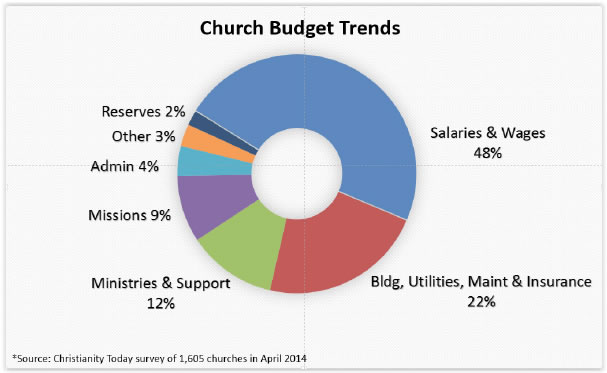

These percentages are not meant to be prescriptive, but comparing your church activity to these averages may be helpful or insightful.

Here are some additional ideas to consider as you develop and review your budget:

  • Seek counsel within your network of pastors who may be in a similar sized church or face similar socio-economic factors. Even if your church doesn’t fit precisely into the same model as another church, the comparison of where your church is on staffing levels, debt, facility expenses, number of individuals being served, etc., can be extremely valuable in helping you establish an appropriate budget for your church.
  • Consider your mission and vision for the church. Create a budget that reflects those priorities. For example, if the church has a vision to reach young families, more funds may be allocated to developing family-friendly environments, programs, and outreach opportunities.
  • Consult experienced members within your church for help. Find businessmen and -women within your church who create and execute budgets as part of their daily job. They will have expertise that will be invaluable to you.
  • Lastly, the IRS requires compensation provided to ministers to be reasonable. As you create your budget and review compensation packages, one way to determine reasonableness is to consult independent compensation surveys for comparison. Christianity Today has a great compensation tool for churches.  You can find that at churchsalary.com.

The Southern Baptist Convention also publishes a compensation survey that is freely available on their website.

Related Posts

Contractors Vs Employees

Contractors Vs Employees

Q: How do we determine whether staff are to be treated as employees or self-employed? A: The IRS provides several tests for determining whether someone should be classified as an employee or contractor. In fact, there are at least four sets of standards that have been...

read more...