
Can A Church Share Sales Tax Exemption?

In most states, churches are exempt from paying sales tax.  However, some states do not give this benefit to all nonprofits.  In this particular case, the state has decided that a not-for-profit food pantry will not be exempt from paying sales tax.

While the intent is to help the food pantry keep their costs down by avoiding sales tax, it is not appropriate for the church to allow another organization to use the church’s sale tax exemption form to avoid paying sales tax.

For whatever reason, this particular state has determined that a food pantry will have to pay sales tax on its purchases.  The state remarked in its denial letter that “most nonprofit, community service organizations do not enjoy sales tax exemption status.” Therefore, the food pantry is expected to pay sales tax in this state.

Allowing the food pantry to use the church’s sales tax exemption would be an obvious attempt to bypass state laws, which could be construed as tax evasion.  No church wants to be associated with tax evasion!

However, the church could support the food pantry by purchasing supplies and donating them to the organization because one 501(c)3 can make donations to another 501(c)3.

But, if the church requests payment, or a “donation” in exchange for the supplies, I believe the same negative conclusion can be made. The reality of the transaction is that the two organizations are trying to get around state sales tax laws.

I would caution you from these arrangements, so that no one can accuse the church of unethical actions, or at worst, tax evasion.
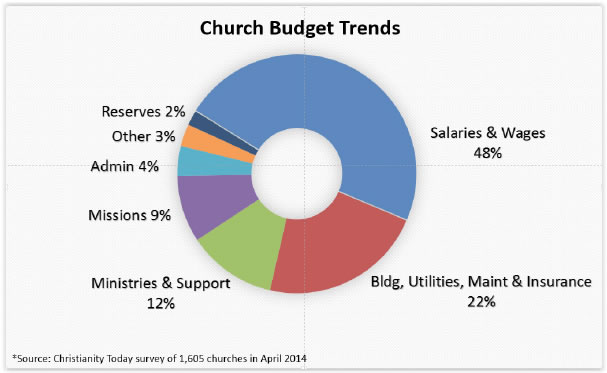

These percentages are not meant to be prescriptive, but comparing your church activity to these averages may be helpful or insightful.

Here are some additional ideas to consider as you develop and review your budget:

  • Seek counsel within your network of pastors who may be in a similar sized church or face similar socio-economic factors. Even if your church doesn’t fit precisely into the same model as another church, the comparison of where your church is on staffing levels, debt, facility expenses, number of individuals being served, etc., can be extremely valuable in helping you establish an appropriate budget for your church.
  • Consider your mission and vision for the church. Create a budget that reflects those priorities. For example, if the church has a vision to reach young families, more funds may be allocated to developing family-friendly environments, programs, and outreach opportunities.
  • Consult experienced members within your church for help. Find businessmen and -women within your church who create and execute budgets as part of their daily job. They will have expertise that will be invaluable to you.
  • Lastly, the IRS requires compensation provided to ministers to be reasonable. As you create your budget and review compensation packages, one way to determine reasonableness is to consult independent compensation surveys for comparison. Christianity Today has a great compensation tool for churches.  You can find that at churchsalary.com.

The Southern Baptist Convention also publishes a compensation survey that is freely available on their website.

Related Posts