
Are Credit Card Statements Adequate Documentation?

Q: Some of our staff use personal credit cards to make approved purchases for the church. When reimbursing the employee for the purchase, is the credit card statement adequate support?

A: Credit cards are certainly a convenient way to make business purchases. But complying with an accountable reimbursement plan requires adequate substantiation for all business expenses. Often times, it is hard to keep track of all those receipts, so using the credit card statement may seem like a reasonable solution.

A credit card statement can be adequate to prove that a purchase was made, but in most cases additional documentation will be needed to comply with the requirements of an accountable reimbursement plan.

For example:

  • A credit card statement will identify a purchase that was made at a store, but it won’t describe the items that were included in the purchase.
  • A credit card statement will identify a purchase at a restaurant, but it won’t identify the number of people participating or the business purpose of the meal.
  • A credit card statement may show a recurring monthly subscription, but additional support will be needed to identify why the subscription qualifies as a necessary business expense.

For these reasons, a credit card statement by itself will usually not be sufficient to support a business expense.

For further information, see these IRS publications:

463, Travel, Entertainment, Gift, and Car Expenses.

583, Starting a Business and Keeping Records.
4221pc, Compliance Guide for 501(c)(3) Public Charities.

1828, Tax Guide for Churches and Religious Organizations.

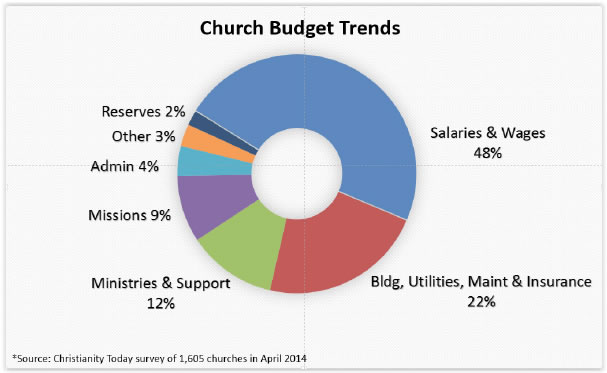
These percentages are not meant to be prescriptive, but comparing your church activity to these averages may be helpful or insightful.

Here are some additional ideas to consider as you develop and review your budget:

  • Seek counsel within your network of pastors who may be in a similar sized church or face similar socio-economic factors. Even if your church doesn’t fit precisely into the same model as another church, the comparison of where your church is on staffing levels, debt, facility expenses, number of individuals being served, etc., can be extremely valuable in helping you establish an appropriate budget for your church.
  • Consider your mission and vision for the church. Create a budget that reflects those priorities. For example, if the church has a vision to reach young families, more funds may be allocated to developing family-friendly environments, programs, and outreach opportunities.
  • Consult experienced members within your church for help. Find businessmen and -women within your church who create and execute budgets as part of their daily job. They will have expertise that will be invaluable to you.
  • Lastly, the IRS requires compensation provided to ministers to be reasonable. As you create your budget and review compensation packages, one way to determine reasonableness is to consult independent compensation surveys for comparison. Christianity Today has a great compensation tool for churches.  You can find that at churchsalary.com.

The Southern Baptist Convention also publishes a compensation survey that is freely available on their website.

Related Posts

Budgeting Beyond the Basics

Budgeting Beyond the Basics

Whatever size church you lead, you can manage your finances effectively without sacrificing your mission. And managing your budget is one of the keys to balancing finances and mission. When it comes to church finances, people are usually concerned about the same...

read more...