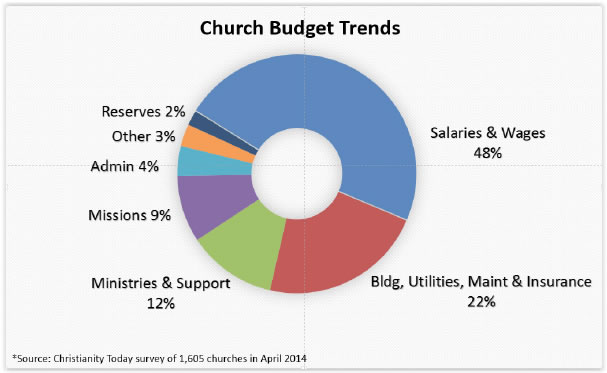
When it comes to the matter of a church budget there may be some that say “Who needs a budget? The Lord will provide our needs. Budgets just put restrictions on the work of the Holy Spirit.” To those people, budgets are often viewed as negative and unnecessary. However, in contrast, most church leaders believe that in order for their church to be successful in the management of its financial resources a church budget is an absolute necessity.
It has been said that budgeting is the skillful art of allocating limited resources to unlimited demands. Jesus seemed to endorse the idea of budgeting in Luke chapter 14 when he asked the question of the one who wants to build a tower: “Won’t you first sit down and estimate the cost to see if you have enough money to complete it?” Jesus was concerned about the builder being able to finish the project, but I believe that Jesus would have just as much concern about the day to day costs of operating the tower. After all, there would be routine maintenance, utilities, insurance, and labor expenses associated with the tower operation.
We have the same concerns about churches and church programs. Not only should there be enough funds to build the church or start the program, but there must be sufficient funds to keep the church and programs functional and operating.
Even those who see the value of having a church budget may not understand that a certain amount of planning needs to take place before a church budget is constructed. You may ask, “What is the difference between planning and budgeting?” Planning involves the development of a mission statement. Planning also requires the establishment of goals, objectives, and priorities.
In the planning process, questions will need to be answered that define the direction the church wants to go. While some of those questions will be addressed later, in order to have a meaningful budget, be prepared to do some planning first.
Planning and the Mission Statement
The mission statement should clearly define what is important to your ministry. In the planning process, develop a clear, concise, mission statement that is approved by the board, regularly reviewed, and is communicated and widely understood by all those in the church. Based on the mission statement, those in leadership can recommend specific goals and objectives to the board or budget planning committee for discussion and approval. Having this information prior to the beginning of the budget process will help to provide a unifying effect among the final approvers of the budget.
Planning with Goals and Objectives
Church and program leaders should clearly define what their goals and objectives are for the ministries for which they are responsible. Having clearly defined goals and objectives will help facilitate the assessment of the value of each program as well as offering a basis on evaluating the performance of those responsible for the program. Again, the goals and objectives of each program should support the mission statement of the church.
Planning and Establishing Priorities
Usually a church does have limited resources; therefore, it becomes vital to the church operation that priorities for spending need to be established. This requires strategic planning. It is a fairly simple process to establish spending priorities for necessities such as rent, utilities, insurance, and certain salaries. It is not so simple when you are prioritizing the programs involved in the church. Which is more important: missions or children’s ministries? Is the music program a greater priority than the youth program? Although not necessarily easy, the establishment of priorities is extremely valuable when going through the budget process. The programs viewed as priority programs should receive priority in the budget process. Again, how a program supports the mission statement of the church must be considered when establishing priorities.
Planning Involves Asking the Difficult Questions
There are certain questions that need to be asked in the planning process that will impact the budget process. Honestly addressing these questions will provide valuable input to church leadership in establishing the direction the church is to go. Here are a few questions. You may have others that are just as insightful:
- If the church were to cease operation, what difference would it make? Answering this question will let you know who is most impacted by the ministry of the church.
- If the church budget were cut in half, what things would you keep? This is a great question in establishing priorities.
- What did we do right in the past year? Doing the right thing often bears repeating.
- What did we do wrong in the past year? Often church leaders place items in the budget simply because the item was in the previous year’s budget. They fail to ask if the item was successful and promoted the mission of the church.
- What should we discontinue? Are there activities or programs whose time is past and should no longer be funded?
- What ministry area should we expand, enhance, or begin in the next year?
- Are new ministries consistent with the goals and objectives of the church?
- Is there sufficient staff to implement our plan? Sometimes plans are very ambitious and lack the staffing required to sustain them. It is like building the tower, but not having enough funds to pay the operational costs.
God has blessed churches with tithing members to provide the resources to do the work of the ministry. Stewardship of those resources is an important responsibility that should not be taken lightly.
Churches that stay focused on their strategic plan know exactly how to spend their limited resources. Be sure that there is a good understanding of church priorities, goals, and objectives so that all spending decisions are made in accordance with your strategic plan and vision.